
September 16, 2026
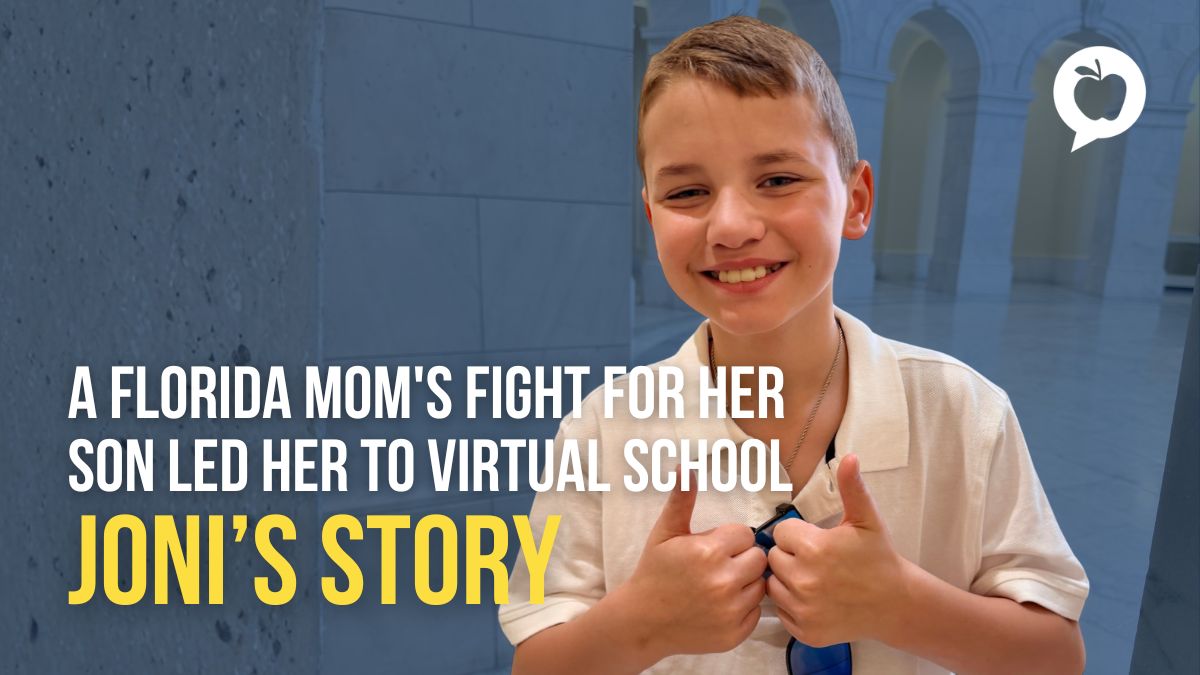
A Florida Mom's Fight for Her Son Led Her to Virtual School, and It Changed Everything
What’s a Rich Text element?
What’s a Rich Text element?
What’s a Rich Text element?
What’s a Rich Text element?
What’s a Rich Text element?
What’s a Rich Text element?
The rich text element allows you to create and format headings, paragraphs, blockquotes, images, and video all in one place instead of having to add and format them individually. Just double-click and easily create content.
- testing number bullets
- and two
- and now threeee
Static and dynamic content editing
A rich text element can be used with static or dynamic content. For static content, just drop it into any page and begin editing. For dynamic content, add a rich text field to any collection and then connect a rich text element to that field in the settings panel. Voila!
- Testnig one bullet
- two bullets
- and now three

How to customize formatting for each rich text
Headings, paragraphs, blockquotes, figures, images, and figure captions can all be styled after a class is added to the rich text element using the "When inside of" nested selector system.
Joni still remembers the day she knew her son Joey would never set foot in a traditional classroom again. He was ten years old, sitting in a traditional, brick-and-mortar in Florida, and he had asked to leave his seat because he was feeling sick. His teacher told him no. He asked again. She still said no.
Joey was so sick, he ended up having an accident. When he asked to call his mother, the answer was still… no.
At the end of the day, Joey told his mom that he was forced to sit in soiled pants for over 5 hours. "I knew in that exact moment he would never go back to that school again," said Joni.
That afternoon became the turning point for her family, beginning the story that plays out in millions of households in the state of Florida and across the U.S. As more families discover public virtual schools, they recognize that school options can be the difference between a child who dreads school and a child who thrives in it.
During the 2023 to 2024 school year, Joey was failing. Homework rarely came home. Joni emailed teachers and tried calling the school to find out what was going on and how she could help her son get his grades up. Nobody called back.
She was doing everything a parent is supposed to do, and getting nowhere. Something wasn't adding up, and no one at the school seemed interested in figuring out what it was.
A Florida Mom Discovers the World of Online School
Around that time, friends of the family had already moved their kids into virtual school. It fit their travel baseball schedule, and it looked like something Joni had never considered for her own son. Before she and Joey even left the parking lot that day, Joni had pulled up enrollment forms for a free public virtual school option.
The woman who helped enroll Joey was, in Joni's words, amazing. Joni mentioned that Joey didn't have an Individualized Education Plan, but she had a feeling he needed one. She knew he was struggling. She just didn't know how to fix it.
Within the first week of online school, Joey's new teacher noticed he was struggling to read and ran a diagnostic. That diagnostic set everything in motion.
The Diagnosis That Changed Joey's Story
A school psychologist stepped in and started a sixty day evaluation. Joey qualified for an IEP for reading comprehension, a struggle that was bleeding into math because of word problems he could not fully understand.
The plan that followed gave Joey extra time on tests, extra days for assignments, a fidget tool to help him concentrate, and a reduced workload, since the full course load would have added up to eleven hour school days, seven days a week. Reading material got read aloud so he could comprehend it instead of getting stuck decoding words on a page.
Joey is not missing a single thing the state requires him to know. The material is simply presented in a way his brain can absorb it.
The results speak for themselves. Joey is now a straight A student in the fifth grade.
From Dreading School to Missing It
Before virtual school, mornings were a battle. Joey begged to stay home. He begged to be homeschooled. Kids at his old school told his mother that his teacher hated him. He dreaded school every single day.
Now the guest room in their house is Joey's classroom, and he says he feels safer there. He has gained independence he never had before. He manages his own schedule. He is more confident, and Joni is right there with him, encouraging him through every assignment.
"His personality has changed completely," Joni said. "He used to say, I'm stupid, I know I'm stupid. Now he knows he can do it. He looks forward to getting straight As and working hard. All because we made a change."
Joni describes the shift as night and day. On the third day of summer vacation this year, Joey told his mother he missed school. The boy who once dreaded the building now misses the version of school built around him.
"It has been a life changing experience," Joni said. "It works for us. It's the best thing that could have ever happened to us."
A Classroom That Travels With the Family
Joey started tae kwon do in first grade because he wanted to be a ninja like a character on his favorite TV show. He stuck with it and grew into a national tae kwon do champion.
Virtual school made that possible without sacrifice. When Joey had a national tournament in May, Joni let the school know he would be out Thursday and Friday. The answer was simple. He could log into class from his phone in the car. He finished assignments in the hotel room between matches, and on a family cruise, he did his schoolwork onboard so there was no need to fall behind or burn an absence.
Joni's husband works in the oil field in North Dakota while the family lives in Florida. Virtual school gives them a flexible schedule that lets them spend real time together as a family instead of building their lives around a rigid school calendar.
"It works out better for our family," Joni said.
Finding Her Voice as an Advocate
Joni used to believe her job was simply to be a parent, not the teacher, and that the school always knew best. That belief cracked when she couldn't get a straight answer about how to help her own son.
Virtual school gave her a front row seat, letting her sit in on Joey's classes and text his teacher directly to become a better learning coach at home.
That front row seat mattered in February this year, when the school tried adding Joey to extra classes outside his IEP. Joni is a current college student, and one of her required courses covered core principles of social justice, including the difference between equity and equality. She recognized instantly that what Joey needed was equity, not more work piled onto an already reduced load.
She emailed his teacher. With all due respect, she wrote, no one had asked whether Joey could be added to the extra class. Per his IEP, he has a reduced workload, and she was requesting he be removed.
"At that moment, I knew they couldn't shut me up," Joni said. "If I don't advocate for him, he will get lost in the system. I have worked too hard and too long to get him away from hating school. I have to protect that, and him, at all costs."
Joni never expected to become a mama bear ready to fight. She still wants to collaborate and encourage everyone around her son. But she learned that too much support can become counterproductive, and someone has to guard the joy the family fought so hard to get back.
"I didn't know I had options," she said. "I didn't know there was a free virtual school. I didn't know I could stand up and say, hey, this isn't working. If I didn't know, other parents don't know either. I want to be the one to say, you aren't crazy. I know what it's like to find your voice and say, this is not how it will go for my kid. I had to learn the hard way. So did my son. We are not alone in this."
Taking Joey's Story to the Capitol
Last October, Joni and Joey met with a state senator to say thank you for supporting Florida school choice. Joey brought his schoolwork and showed it off. When the family later traveled to Washington, D.C., legislators there were just as receptive, and impressed most by Joey himself. He answered questions in his own words, unashamed and confident, talking about his school and his life like any other kid his age.
For Joni, that confidence is the whole story of school choice in miniature. A boy who once sat silently in a chair for five hours, too afraid to advocate for himself, now sits across from lawmakers and speaks up without hesitation.
Florida families looking into virtual school or online school for a struggling child, academically, socially, or emotionally, are not alone. Joni's advice is simple. Ask questions, know your options, and never stop advocating. Sometimes the right fit isn't the school down the street. It's a guest room turned classroom, a flexible schedule, and a mom who finally found her voice.


