
September 23, 2026
How Tennessee Virtual Academy Helped This Future Business Leader Find Her Path
What’s a Rich Text element?
What’s a Rich Text element?
What’s a Rich Text element?
What’s a Rich Text element?
What’s a Rich Text element?
What’s a Rich Text element?
The rich text element allows you to create and format headings, paragraphs, blockquotes, images, and video all in one place instead of having to add and format them individually. Just double-click and easily create content.
- testing number bullets
- and two
- and now threeee
Static and dynamic content editing
A rich text element can be used with static or dynamic content. For static content, just drop it into any page and begin editing. For dynamic content, add a rich text field to any collection and then connect a rich text element to that field in the settings panel. Voila!
- Testnig one bullet
- two bullets
- and now three

How to customize formatting for each rich text
Headings, paragraphs, blockquotes, figures, images, and figure captions can all be styled after a class is added to the rich text element using the "When inside of" nested selector system.
Grace Horvath was in the fifth grade when the world shut down and school moved online. For most families, that shift was a temporary scramble. For Grace's family, outside Knoxville, Tennessee, it was the beginning of a school experience that fit their life better than the one they left behind.
Grace had already spent time in an online homeschool program and she liked it. When the pandemic hit, the decision to switch to full-time virtual wasn't so much a choice as it was a necessity. Her grandmother and mother had both suffered strokes, and her immune systems were compromised. Keeping the family safe meant keeping school at home.
What started as a precaution turned into a preference. Now a sophomore at Tennessee Virtual Academy (TNVA), Grace says the switch was one of the best things that happened to her education.
"I genuinely like online school more," she says. She found plenty of friends, a full course load, and an environment that never felt isolating the way people assume virtual school might. She takes electives. She has club meetings with her friends. None of it feels like a downgrade from a traditional classroom.
That wasn't always the case. Grace is quick to point out the difference between the improvised online learning of 2020 and the structure of the public virtual school she attends now. TNVA runs like a real classroom, just online, complete with real classmates, real teachers, and far more one-on-one attention than she expected. "I can ask my teacher all the questions I need to," she recalls, "and they are always there."
Grace's favorite part of virtual school is simple: she gets to learn in a safe, comfortable environment, in her own home. And this environment is by no means passive. Students still have to get on the microphone and talk to each other, and Grace credits that structure with building real communication skills. She also points to the community at TNVA as something people underestimate. When she got stuck on math homework, she emailed her teacher and got a fast, thorough response. "In all classes there are at least three students willing to help you," she says, "and the teacher is always there for you."
Grace's most visible extracurricular is Future Business Leaders of America, a club she first discovered as a middle schooler through her virtual school. Now in high school, she serves as chapter historian, documenting meetings and events, and the chapter has grown to include many members. Future Business Leaders of America directly reinforces what she's learning in class. After taking Intro to Business and Finance courses, she says she can see exactly how the club's competitions connect to her coursework.
Those competitions cover nearly every interest, from graphic design to finance to community service. Grace chose parliamentary procedure, the formal structure that governs how meetings are run, the same kind of order you'd see at a county commissioner meeting or in any organized business setting. Competitions are held online and scored like an objective quiz. Grace and two teammates won the introductory parliamentary procedure category at the state conference this year and went on to compete at the National Leadership Conference in San Antonio, where Grace placed 1st in the introduction to Parliamentary Procedure competition. "It was a really fun experience," she says, and she came away from it remarking how it was a great venue to network and build connections with other chapters.
Virtual school's flexible schedule, classes run from 8:30 to 11:30 a.m. and 12:30 to 3:30 p.m., gave Grace something a bus schedule never could: the ability to be wherever she needed to be. Last year, that meant frequently going to the hospital with her mother. Grace kept up with schoolwork from the hospital room and never fell behind. With no commute eating into her afternoons, she now spends her free time chasing a growing passion for atmospheric science, devouring everything she can about thunderstorms, tornadoes, and how weather systems work, with an eye toward eventually volunteering with the National Weather Service.
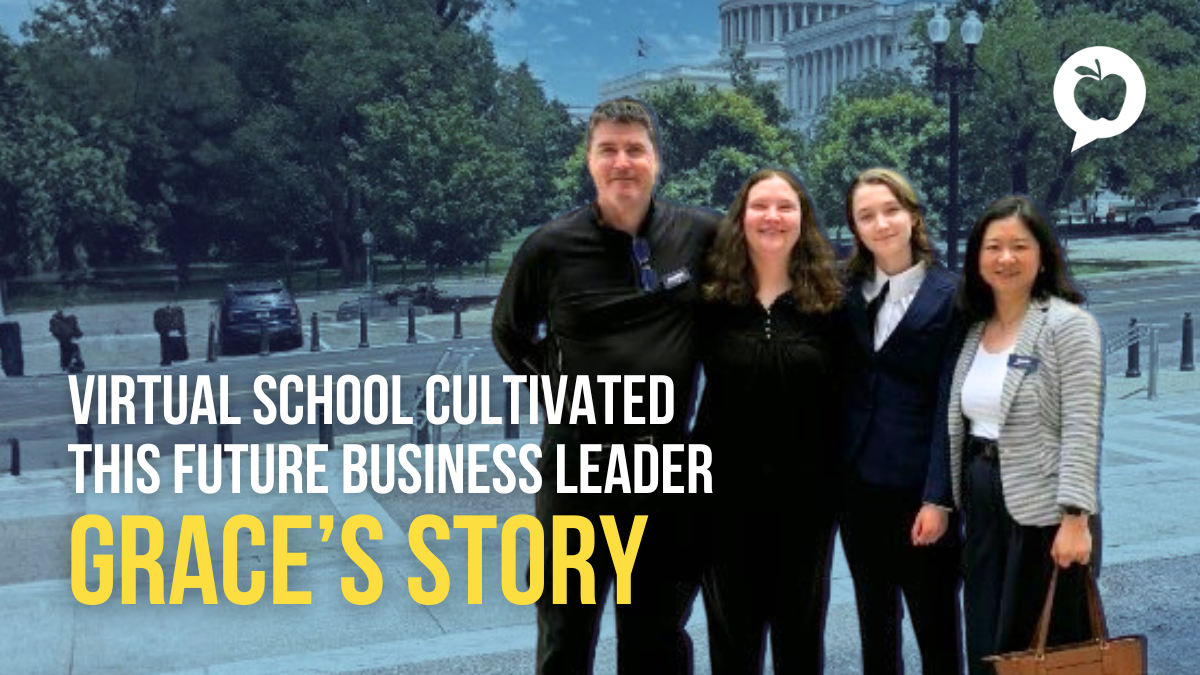
One of Grace's proudest moments came through TNVA's student advocacy program, which took her to Washington, D.C. to meet with legislators and legislative aides. Public speaking has never come easily to her, so stepping into those meetings pushed her well outside her comfort zone. It paid off. She left with a clear message for lawmakers: virtual school should stay protected, not just for her, but for the students coming up behind her who need the same flexibility, or the safety of a learning environment away from in-person bullying.
Grace hasn't settled on a single career path yet. She'd love to attend the University of Tennessee, Knoxville and study atmospheric science, with an eye toward becoming a meteorologist or a marine biologist.
Her mother Melody and father, Ryan, have watched the entire journey unfold. "She has flourished in the program she's been in," Ryan says. "I have no doubt she would be a different person otherwise." For his daughter, virtual school didn't just accommodate a hard season in the family's life. It gave her room to become exactly who she was meant to be.


