December 9, 2025
New National Report Finds 500,000+ Low-Income Virtual Public School Students Are Denied School Meals Because of Outdated Federal Policy
%20(4).png)
What’s a Rich Text element?
What’s a Rich Text element?
What’s a Rich Text element?
What’s a Rich Text element?
What’s a Rich Text element?
What’s a Rich Text element?
The rich text element allows you to create and format headings, paragraphs, blockquotes, images, and video all in one place instead of having to add and format them individually. Just double-click and easily create content.
- testing number bullets
- and two
- and now threeee
Static and dynamic content editing
A rich text element can be used with static or dynamic content. For static content, just drop it into any page and begin editing. For dynamic content, add a rich text field to any collection and then connect a rich text element to that field in the settings panel. Voila!
- Testnig one bullet
- two bullets
- and now three

How to customize formatting for each rich text
Headings, paragraphs, blockquotes, figures, images, and figure captions can all be styled after a class is added to the rich text element using the "When inside of" nested selector system.
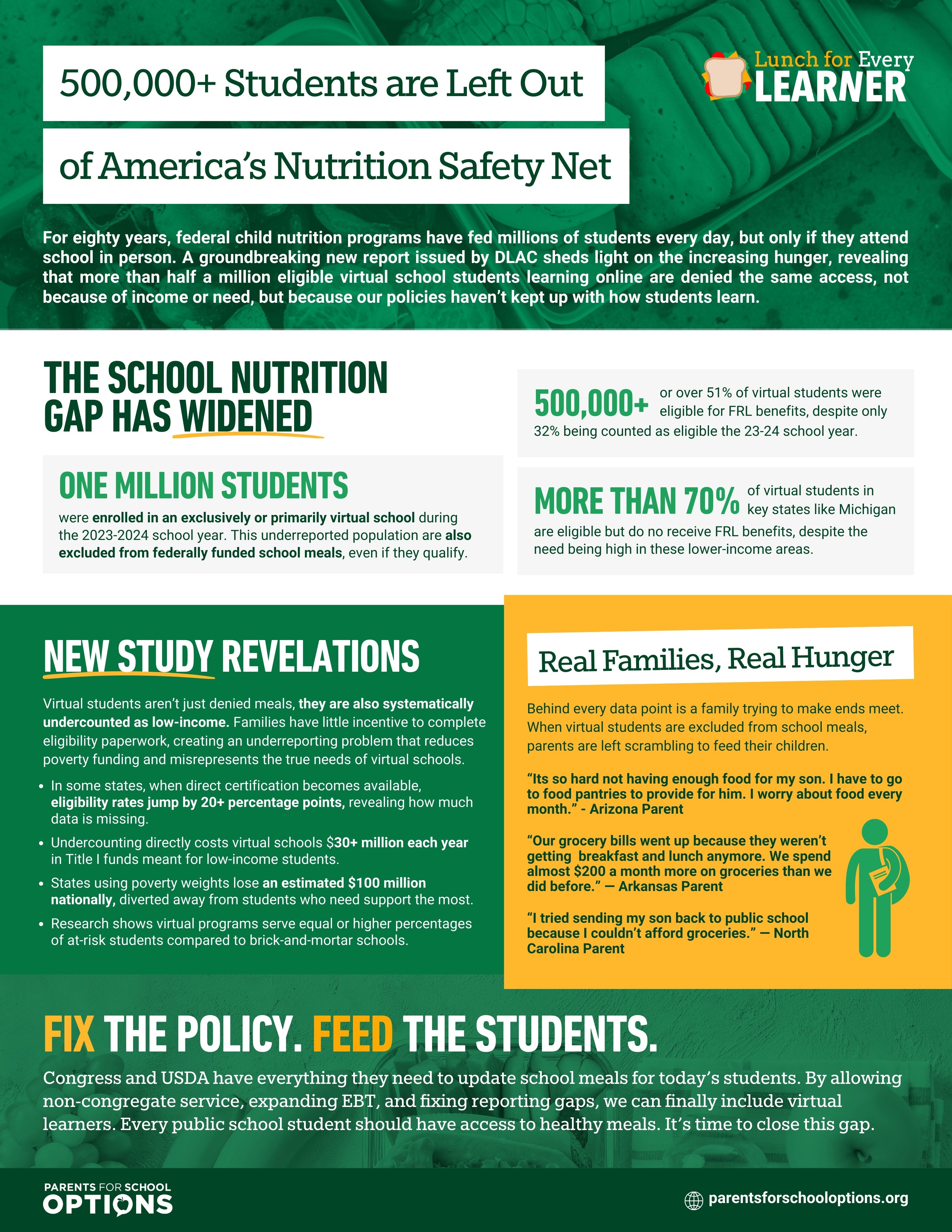
[ARLINGTON, VA, December 8, 2025] A groundbreaking new analysis from the Community Advancing Digital Learning (DLAC) reveals that more than 500,000 income-eligible public school students who attend full-time virtual schools are being denied access to federally-funded school meals, solely because their learning takes place online.
The white paper finds that over 1 million students were enrolled in exclusively or primarily virtual public schools during the 2023–24 school year, and more than half of these students were likely eligible for free or reduced-price meals (FRL).
“No child should go hungry because of the way they learn,” said Letrisha Weber, PSO’s National Board President. “The current and outdated policy is leaving hundreds of thousands of low-income students out of the school meal system, and families are paying the price.
“This is a solvable problem, and Congress and the US Department of Agriculture must act now.”
Key Findings
- 500,000+ students are eligible for FRL benefits but receive no meals at all due to the federal “congregate setting” rule requiring students to eat meals on site.
- Only 32% of virtual students were counted as eligible in federal data last year, despite real eligibility rates exceeding 50%.
- Eligibility rates jump 20+ percentage points in states where direct certification becomes available—showing the extent of underreporting.
- Undercounting costs virtual public schools more than $30 million annually in Title I funds and contributes to an estimated $100 million gap in state funding tied to poverty weights.
The Solution: Modernize School Nutrition Policy to Reflect Today’s Learning Environments
The report calls on Congress and the U.S. Department of Agriculture to update the National School Lunch and Breakfast programs by:
- Modernizing National School Lunch and School Breakfast program eligibility to allow non-congregate meals, parent pick-up, location flexibility, and multi-day meal pick-up and delivery.
- Support state innovation with USDA technical assistance for implementing meal programs across learning models.
- Commission a GAO study on funding and accountability distortions from undercounting.
- Clarify data-reporting guidance to ensure accurate eligibility reporting for virtual programs.
- Encourage long-term alternatives to free and reduced-price meals as a poverty proxy in funding and accountability systems.
“Congress has the tools and precedent to fix this, said Weber. “We proved during COVID that non-congregate meals work. It’s time to update school nutrition for today’s students.”
The full white paper report can be found on DLAC’s website. A summary one-pager is available below and on our website.