
December 3, 2025
School Lunch Case Study: Advocating for Equity in the National School Lunch Program
.jpg)
What’s a Rich Text element?
What’s a Rich Text element?
What’s a Rich Text element?
What’s a Rich Text element?
What’s a Rich Text element?
What’s a Rich Text element?
The rich text element allows you to create and format headings, paragraphs, blockquotes, images, and video all in one place instead of having to add and format them individually. Just double-click and easily create content.
- testing number bullets
- and two
- and now threeee
Static and dynamic content editing
A rich text element can be used with static or dynamic content. For static content, just drop it into any page and begin editing. For dynamic content, add a rich text field to any collection and then connect a rich text element to that field in the settings panel. Voila!
- Testnig one bullet
- two bullets
- and now three

How to customize formatting for each rich text
Headings, paragraphs, blockquotes, figures, images, and figure captions can all be styled after a class is added to the rich text element using the "When inside of" nested selector system.
Hundreds of thousands of families across the United States face an unfair reality nearly every day: children enrolled in full-time virtual public schools are intentionally left out of the National School Lunch Program (NSLP). This exclusion has dire consequences for kids enrolled in these public school programs, as struggling parents are forced to put food on the table when these meals would be otherwise provided for them. In 2025, Parents for School Options (PSO) dedicated many hours to highlighting this issue, sharing the stories of affected families, and laying the groundwork for changes in the system.
Our efforts focused on amplifying parent voices, sharing real stories from families dealing with these challenges, and connecting with key federal stakeholders like the U.S. Department of Agriculture (USDA) and members of Congress. While this work has just begun, the momentum generated in 2025 sets us up for future policy successes that ensure there is a lunch for every learner.
About The Issue
The exclusion of full-time virtual students from the free and reduced lunch program is a major issue that unfairly penalizes families for choosing a public school option that best serves their children’s educational needs.
Many parents turn to full-time online learning primarily for its fully remote setup, which provides a safe, stable, and consistent environment for children with chronic illnesses, those who’ve experienced bullying, or families with transient lifestyles. Beyond safety, online schools offer greater access to teachers and personalized support, often more than traditional brick-and-mortar settings. The flexibility of online learning also allows students to tailor their schedules and pace, making it an ideal solution for families seeking both stability and individualized education when the traditional classroom does not work for their child.
However, across the country today, families who opt-in to virtual learning for whatever reason are facing rising food costs or the difficult decision to return to a brick-and-mortar school that does not service their child as well, simply to access basic nutrition.
“This is not about convenience,” said Texas mother Carkenda, who struggles daily to fully feed herself simply because she chose to send her child to the best school for his learning difference. “We choose virtual learning because it’s what works for my son. Denying meals only makes that choice harder.”
Advocacy Efforts in 2025
Engaging Federal Stakeholders
In June, PSO met with USDA to underscore the shared acknowledgment of the inequity, and agreed that congressional action is imperative in providing these vulnerable children with the nutrition they qualify for and deserve. In addition, PSO staff met with several legislators and members of Congress, focusing on potential legislative solutions, including report language directing USDA to examine virtual student inclusion.
Grassroots Advocacy
In October, PSO advocates sent over 940 letters to offices in Congress urging lawmakers to support an amendment of the NSLP to include full-time online students. Parents across the country participated, demonstrating broad grassroots support and reinvigorating families who had previously been engaged in PSO campaigns.
Centering Parent Voices
Parent Recruitment Survey: PSO surveyed over 250 families to identify those impacted by the NSLP exclusion and gauge interest in sharing their stories. This data informed targeted advocacy, and the PSO digital team began connecting directly with parents willing to provide video testimonials and other content for social media, newsletters, and congressional outreach, including:
Social Media and Blog Content: We continue to highlight both family experiences and key data points to emphasize and publicize how the exclusion of virtual school students from the NSLP impacts real children and families on a daily basis.
National Newsletter: The PSO Monthly Newsletter, which reaches hundreds of thousands of parents, has been utilized over the past few months to spread stories, facts, key information and progress in states, and recruit new parents to our advocacy rankings by showcasing our work on the school lunch issue.
Webinars and thought leadership included a session with PSO Board member Samoy Mainda and Kristen Tyagi, recorded and shared widely on YouTube.
Op-Ed Visibility: PSO Board President Letrisha Weber published an op-ed in The Hill, drawing national attention to the inequity.
During National School Lunch Week (October 13-17), PSO amplified the campaign, highlighting that virtual students remain on the sidelines while their peers benefit from the NSLP. The newly launched #LunchforEveryLearner campaign tied these stories together, including a dedicated landing page educating families on the issue and encouraging action.
.jpg)
Looking Ahead
This work is just getting started. 2025 was about laying the foundation: building relationships with federal and congressional stakeholders, elevating parent stories nationwide, and demonstrating grassroots demand for change. As we move into 2026, PSO is planning several key projects to continue building momentum and prepare for meaningful policy change. These include:
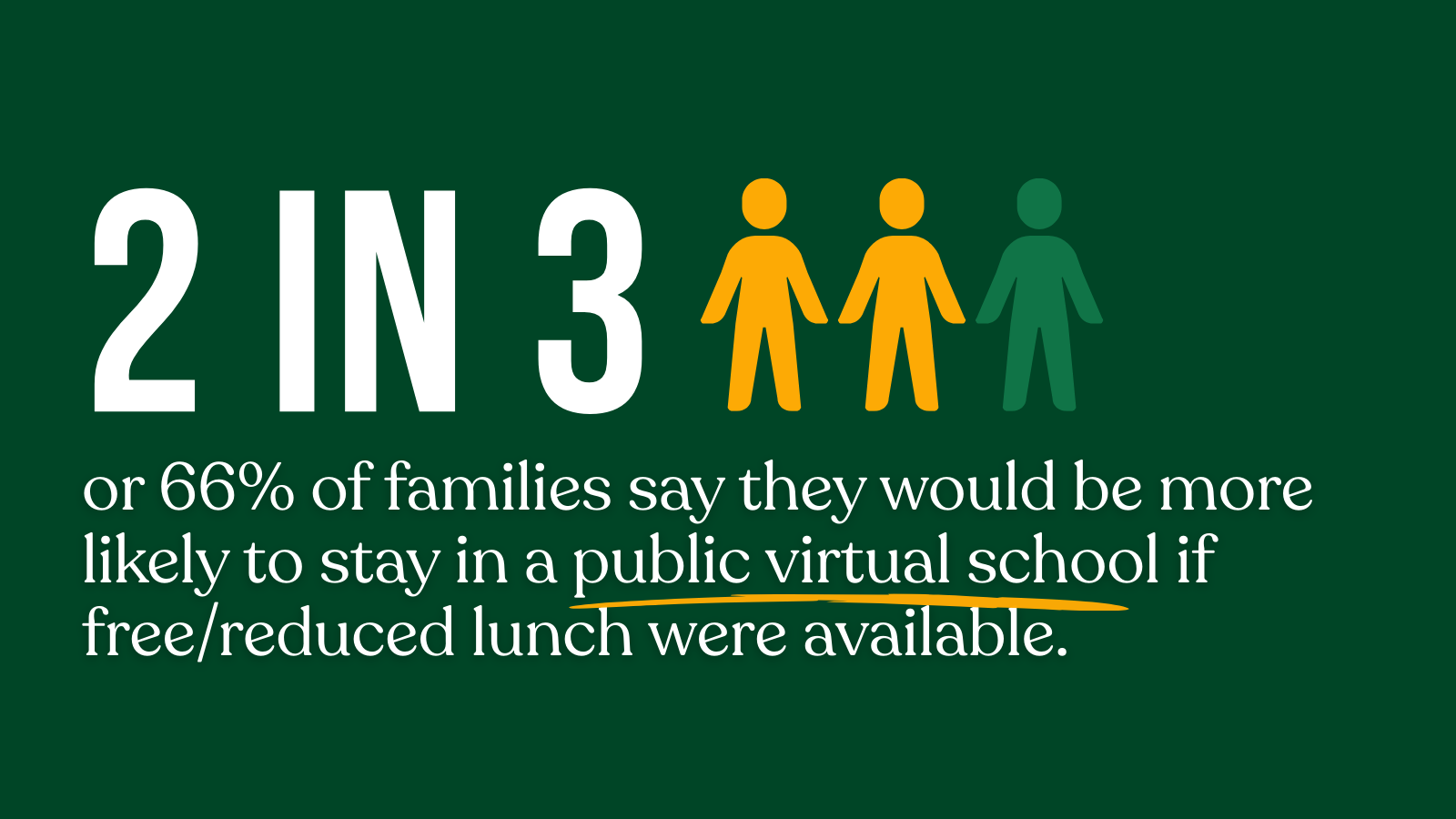
Free and Reduced Lunch National Survey: PSO conducted and released a new national survey in November 2025 of over 1,600 families to better understand their thoughts on the school lunch issue. This survey revealed that 96% of parents support federal action to ensure all public virtual school students can receive free school lunch each day. Our team believes that the staggering insights from this survey will help guide messaging and inform legislators of voter sentiments as we prepare to head into meetings with them in the coming months.
🔗 Read more of our findings here
Coming Soon! DLAC White Paper: In partnership with The Community Advancing Digital Learning (DLAC), PSO has worked on a white paper that explores the history, impact, and potential policy solutions related to the FRL issue.
This paper, authored by researcher Peter Robertson, will be published later this month, and we are confident it will reveal astonishing new findings about this issue and the population size of students impacted.
Conclusion
The effort to ensure full-time virtual students have access to the National School Lunch Program is far from finished. However, 2025 showed the power of parents, coalition-building, and strategic advocacy. PSO’s efforts have built a nationwide network of families ready to advocate, established a growing group of congressional allies, and created a clear narrative about the inequity facing virtual students.
As PSO moves into 2026 and beyond, the lessons learned, stories shared, and relationships built will support meaningful policy change. For hundreds of thousands of virtual students, this fight is about fairness, access, and equity.


